

Types of Yellow Tea: Huang Ya, Huang Xiao & Huang Da
Author: Xu Jiahua, Nationally Certified Senior Tea Appraiser
Chinese yellow tea is commonly grouped by leaf maturity and plucking standard, creating styles that range from delicate bud teas to fuller large-leaf teas. Understanding this classification makes it much easier to place names such as Junshan Yinzhen, Mengding Huangya, and Huo Shan Huang Da Cha within the wider yellow tea family.
How Many Types of Yellow Tea Are There?
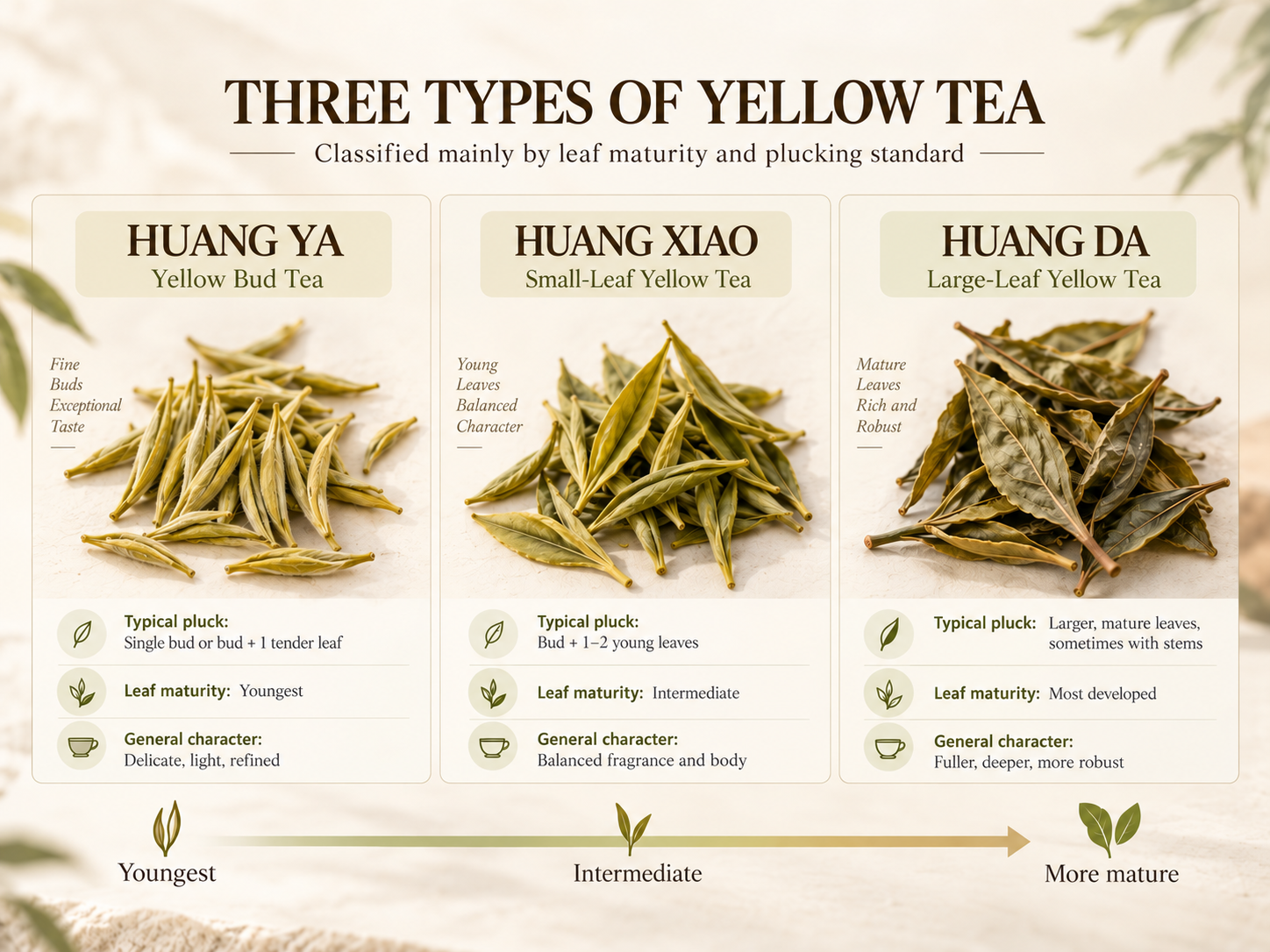
Yellow teas are classified by leaf age into three types: Huang Ya (buds), Huang Xiao (small leaf) and Huang Da (large leaf).
If you have searched for yellow tea, you may have encountered a long list of Chinese names without a clear explanation of how they relate to one another. Huang Ya is typically made from buds or a bud with one leaf, Huang Xiao usually uses a bud with one or two leaves, while Huang Da is made from larger, more mature leaves and may include stems. This three-part classification provides a simple framework for understanding the main yellow tea types before looking at individual regional names. If the category itself is new to you, begin with what yellow tea is, then use the classification below to place each tea within the wider family.
The Three Types of Yellow Tea by Leaf Age
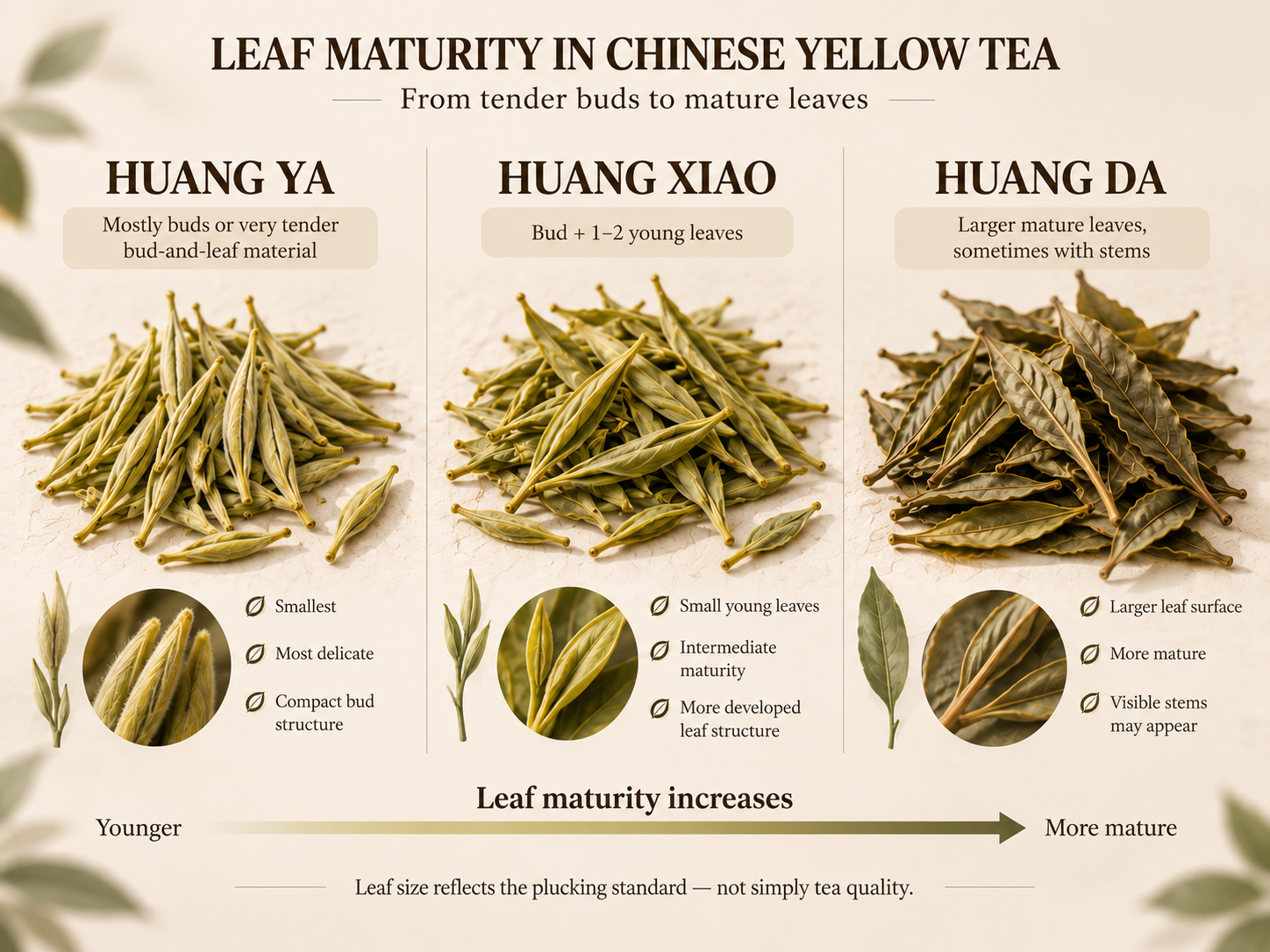
The three types of yellow tea are not a simple ranking from best to worst. Each begins with a different plucking standard, and that choice influences the dry leaf, aroma, texture, and overall intensity of the finished tea.
The three types differ by pluck: Huang Ya uses single buds or a bud with one leaf, while Huang Da uses larger, more mature leaves.
Huang Xiao occupies the middle of the spectrum, commonly using a bud with one or two young leaves. Regional craft and the degree of yellowing still matter, so two teas within the same type will not necessarily taste identical.
|
Yellow tea type |
Typical plucking standard |
General character |
Examples |
|
Huang Ya |
Single buds or one bud with one tender leaf |
Most tender and delicate |
Huoshan Huangya, Junshan Yinzhen |
|
Huang Xiao |
One bud with one or two young leaves |
Intermediate leaf maturity |
Huoshan Huang Xiao Cha |
|
Huang Da |
Larger, more mature leaves, sometimes with stems |
Fuller and more robust |
Huoshan Huang Dacha, Guangdong Dayeqing |
Classification can vary slightly between sources and regional naming traditions, so this guide uses leaf maturity and plucking standard as the main reference.
Huang Ya (Yellow Bud Tea)
Huang Ya, or yellow bud tea, is made from the youngest and most tender material of the three groups. The pluck may consist of a single bud or a bud with one tender leaf, creating a neat appearance and a light, refined cup. Junshan Yinzhen and Mengding Huangya are well-known examples commonly associated with this group.
Huang Xiao (Small-Leaf Yellow Tea)
Huang Xiao Cha, or small-leaf yellow tea, usually is made from a bud with one or two young leaves on it. Compared to Huang Ya, the material used is a bit more developed, but still way younger and smaller than what you'd use for a big leaf tea like Huang Da Cha. And that middle ground can sometimes produce a really nice balance of fragrant, sweet, and full-bodied goodness - neither too delicate like a bud tea, nor too roast-y like a large leaf tea.
Our Huoshan small-leaf yellow tea is the Dofo example that's meant to embody this classification - it's not like every single finished leaf has to be the same size or anything, the term "small leaf" just refers to when the leaves are picked - that's all.
Huang Da (Large-Leaf Yellow Tea)
Huang Da Cha, or large-leaf yellow tea, uses more mature leaves and may include visible stems. It generally produces a fuller-bodied cup, while many traditional Huang Da styles are also known for toasted grain, nutty sweetness, or distinctive roasted aromas. Huo Shan Huang Da Cha and Guangdong Dayeqing are established examples of this group.
Dofo represents this robust end of the category through our Huoshan large-leaf yellow tea and Guangdong Dayeqing large-leaf yellow tea. The leaves may look less delicate than Huang Ya, but that appearance reflects the intended plucking standard rather than automatically indicating lower quality.
For a neutral overview of the category and its named examples, see these yellow tea varieties.
What I Notice When Comparing Huo Shan Huang Ya and Huang Da Cha
When I compare Huo Shan Huang Ya and Huo Shan Huang Da Cha side by side, the difference is much easier to understand than it is from the names alone. Huang Ya shows finer, more tender leaf material and usually gives me a lighter, cleaner cup, while Huang Da Cha has larger leaves and more visible stems, with a deeper-colored liquor, fuller body, and a much stronger toasted character.
In my tastings, I pay particular attention to leaf size, liquor color, body, and roasted aroma because these four points make the contrast between the two styles very clear. Huang Da Cha often reminds me of toasted grain or crisp rice, while Huang Ya stays fresher and more delicate. This is why I do not treat the two as different grades of the same tea; to me, they represent two distinct expressions of yellow tea based on different leaf material and processing.
In my own tea selection work, I deliberately keep Huang Ya, Huang Xiao, and Huang Da in the Dofo Tea range because I do not see them as a ranking from best to worst. Each category shows a different stage of leaf maturity and a different expression of yellow tea. When I compare batches, I look for whether the tea clearly represents the character expected from its category rather than simply choosing the youngest or most delicate leaves. For me, carrying all three gives tea drinkers a more complete understanding of what yellow tea can be.
Famous Yellow Teas You Should Know
Three names appear especially often when people discuss China’s best-known yellow teas. Junshan Yinzhen, also written Jun Shan Yin Zhen, is a Huang Ya tea from Junshan Island in Hunan and is widely regarded as one of the most famous examples of Chinese yellow tea.
Mengding Huangya is another renowned Huang Ya tea, traditionally associated with the Mengding Mountain area of Sichuan. Huoshan Huangya, from Anhui Province, is also commonly included among China’s best-known yellow bud teas.
These three teas all fall under that broad Huang Ya category but because they're made in different places and have their own unique ways of being made - their names get used a bit loosely. Just to be clear, they're here because they're examples of famous yellow teas not because we're going out of our way to tell you about specific products we sell. If you want more context on the wider world of Chinese tea, then check out our guide to famous Chinese teas.
How the Three Types Taste and Differ
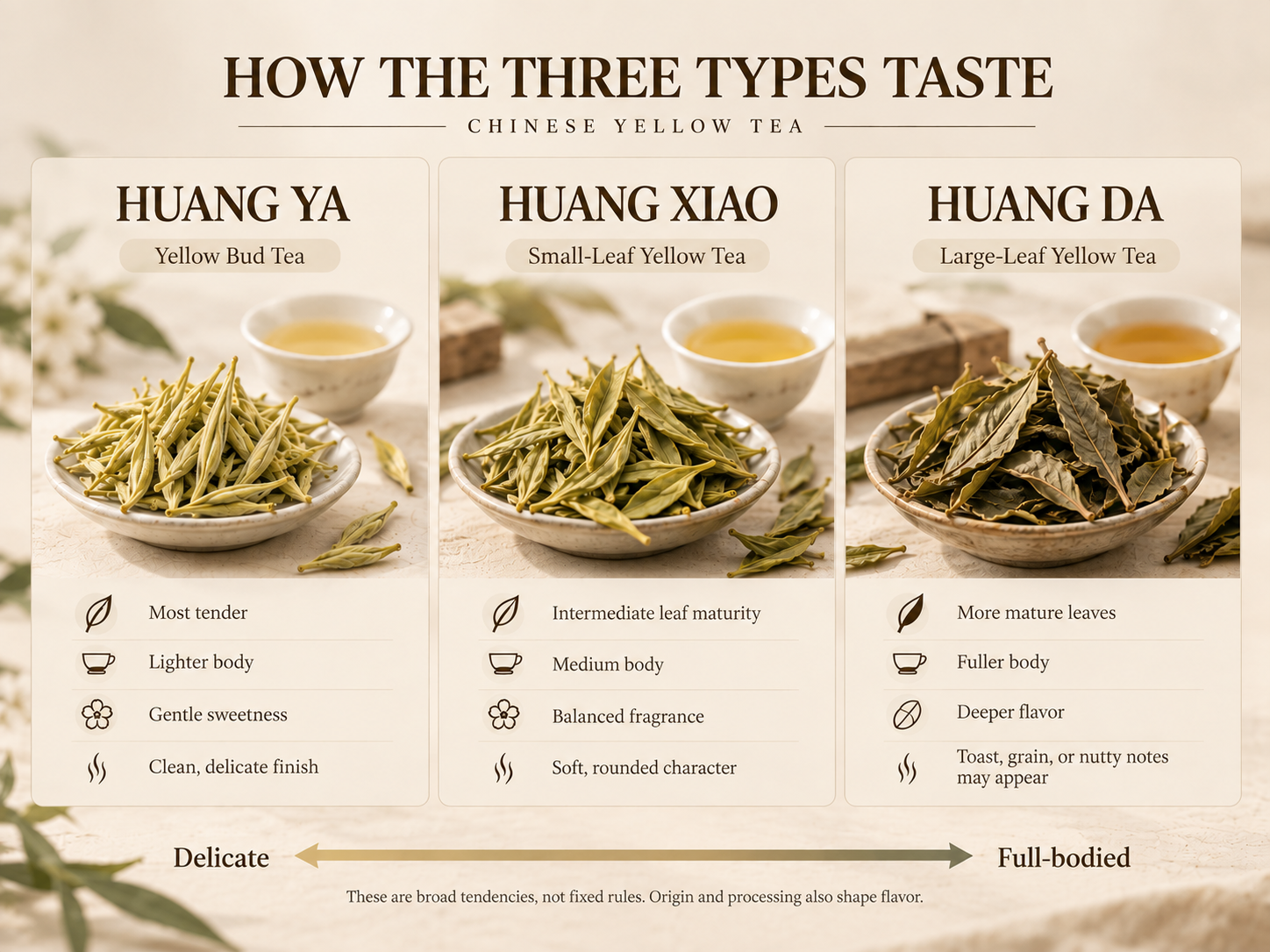
Leaf maturity provides a useful starting point for understanding how the three types of yellow tea differ in the cup. Huang Ya, made from the youngest buds and leaves, is generally the most delicate, with gentle sweetness, a lighter body, and a clean finish. Huang Xiao sits between the two, usually offering more body than Huang Ya while still retaining a soft, fragrant character.
Huang Da uses more mature leaves and tends to taste fuller and deeper, often showing toasted grain, nutty notes, or a noticeable roasted character. These are broad category-level tendencies rather than fixed rules, because origin and processing can still change the final flavor. The main difference comes from leaf maturity, while processing further shapes the cup; see how yellow tea differs from green for the broader comparison.
Which Type of Yellow Tea Is Right for You?
Choose by the kind of experience you want rather than assuming the most delicate tea is automatically the best. If you prefer fresh sweetness, tender leaves, and a lighter cup, Huang Ya is the natural category to explore, although Dofo does not currently sell a Huang Ya tea.
If you want a balance between fragrance and body, consider our Huoshan Huang Xiao tea. If you enjoy a fuller texture and a more noticeable toasted aroma, our Huoshan Huang Da tea is the more natural direction.
For a separate decision guide, see how to choose a yellow tea, or compare the available styles in our yellow tea collection.
If you're new to yellow tea, start with a Huang Ya bud tea like Huo Shan Huang Ya — it shows the style at its most delicate.
FAQ
What are the types of yellow tea?
Yellow tea is commonly classified by leaf maturity and plucking standard into three types: Huang Ya, made from buds or very tender material; Huang Xiao, made from young small-leaf material; and Huang Da, made from larger, more mature leaves. Famous Huang Ya examples include Junshan Yinzhen, Mengding Huangya, and Huo Shan Huang Ya.
What is the most famous yellow tea?
Junshan Yinzhen is often regarded as one of the best-known yellow teas. It is a Huang Ya tea from Junshan Island in Hunan, traditionally made from uniform bud material. Mengding Huangya and Huo Shan Huang Ya are two other important yellow bud teas.
What is the difference between Huang Ya and Huang Da?
Huang Ya uses single buds or very tender bud-and-leaf material, while Huang Da uses larger and more mature leaves, often with stems. As a result, Huang Ya is usually fresher, sweeter, and more delicate, whereas Huang Da is fuller, more robust, and more likely to show a toasted aroma.
Which type of yellow tea is best for beginners?
Huang Ya is usually the easiest starting point for beginners because its tender material produces a fresh, sweet, and delicate cup. Huo Shan Huang Ya is a representative example; read the dedicated Huo Shan Huang Ya guide or see how to choose a yellow tea for the next step.


