

Does Yellow Tea Have Caffeine? How Much, and How It Compares
Author: Xu Jiahua, Nationally Certified Senior Tea
Yes, yellow tea contains caffeine, but the amount varies depending on the tea and how it is brewed. Research has measured roughly 14–53 mg per 200 mL under different brewing conditions, so there is no single fixed number for every cup.
In this guide, we’ll look at how much caffeine yellow tea contains, what affects it, and how it compares with green, oolong, and black tea.
Does Yellow Tea Have Caffeine?
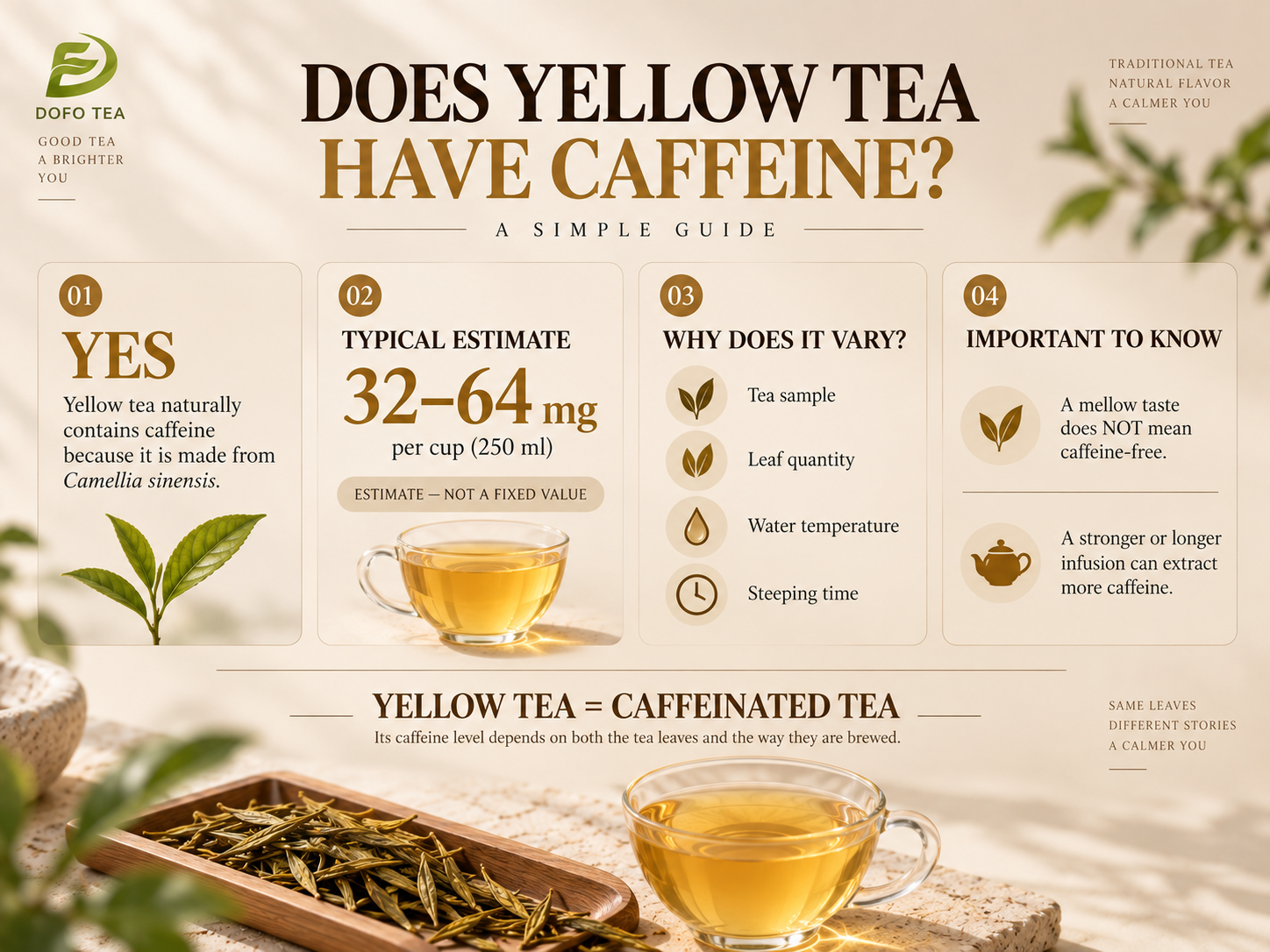
Yes—yellow tea contains caffeine, typically around 32–64 mg per cup, placing it in the low-to-moderate range.
That figure is an estimate rather than a fixed amount: laboratory tests show that the result changes with the tea sample, leaf quantity, water temperature, and steeping time.
Yellow tea contains caffeine because it is made from Camellia sinensis, the same tea plant used for green, oolong, and black tea. Its mellow taste does not mean that it is caffeine-free, and a longer or stronger infusion can deliver more caffeine than a lighter brew. If the category is new to you, begin with what yellow tea is before comparing individual styles.
How Much Caffeine Is in Yellow Tea? (mg per Cup)
Yellow tea caffeine content is commonly estimated at about 32–64 mg per cup, but that range needs context. A 2009 study of caffeine in tea measured one yellow tea sample at approximately 3.18% caffeine by dry weight using HPLC-PDA. That equals about 31.8 mg of caffeine in one gram of dry tea.
Multiplying that figure by two grams gives roughly 63.6 mg present in the dry leaves, but it does not prove that all of it enters the cup. Only part of the caffeine in dry leaves is extracted into the water, and the amount changes with the brewing method.
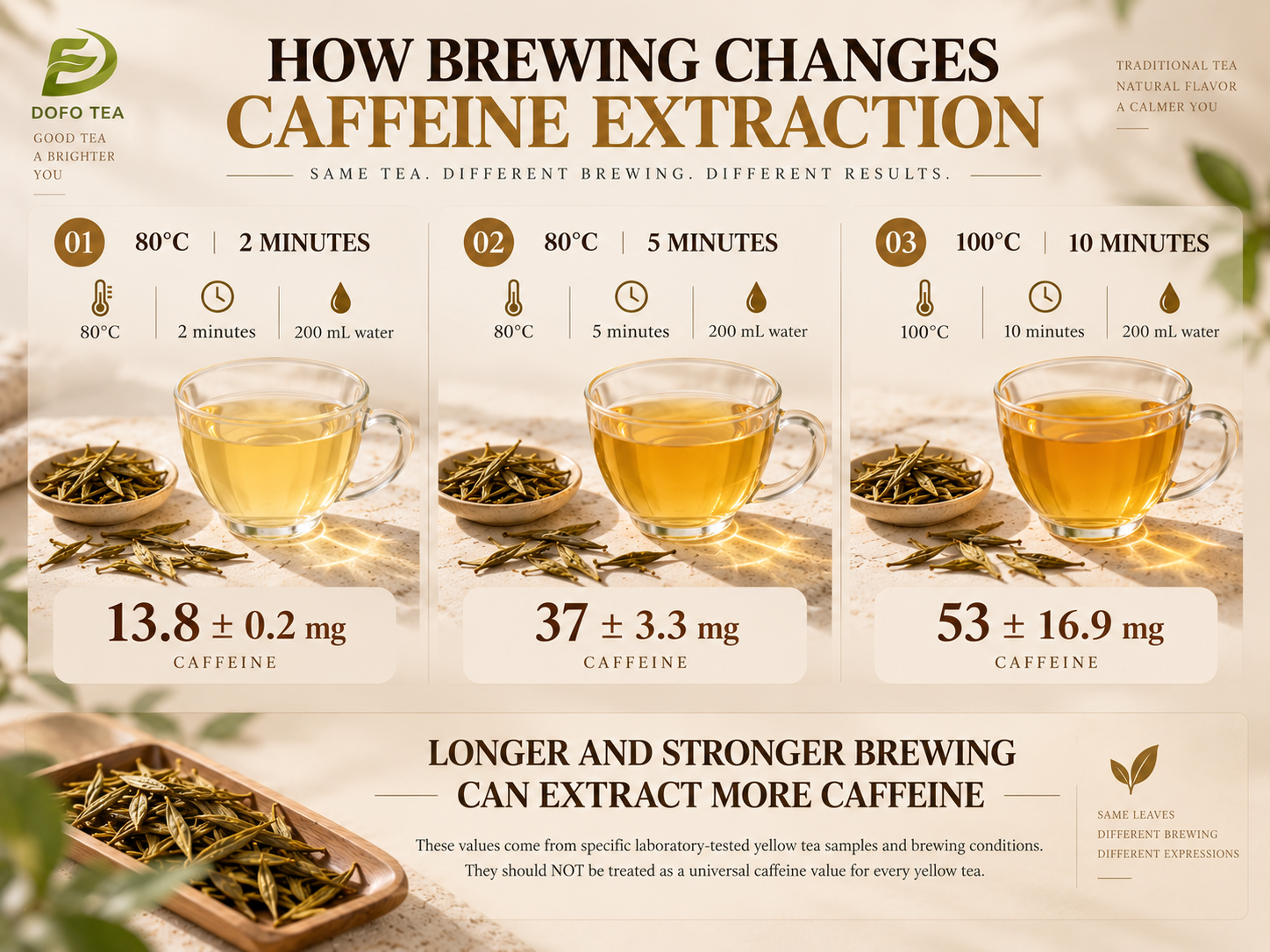
A newer 2025 HPLC study on tea caffeine content measured caffeine directly in brewed tea. Using about 2 g of tea per 200 mL of water, yellow tea contained 13.8 ± 0.2 mg/200 mL after two minutes at 80°C and 37 ± 3.3 mg/200 mL after five minutes at the same temperature. Under a much stronger condition of 100°C for ten minutes, the measured caffeine level reached 53 ± 16.9 mg/200 mL.
These figures should not be combined as though they describe the same measurement. The earlier study reports caffeine in the tea material, while the 2025 study measures caffeine that actually entered the infusion. For that reason, any yellow tea caffeine estimate should be read together with the amount of leaf, water volume, temperature, and steeping time.
Caffeine by Source and Method
|
Source |
Caffeine value |
Method / condition |
What it means |
|
2009 caffeine study |
3.18% dry weight |
HPLC-PDA |
Caffeine in the tested dry yellow-tea sample, not the brewed cup |
|
2025 infusion study |
13.8 ± 0.2 mg/200 mL |
2 g, 200 mL, 80°C, 2 min |
Caffeine measured in the infusion |
|
2025 infusion study |
37 ± 3.3 mg/200 mL |
2 g, 200 mL, 80°C, 5 min |
Longer brewing extracted more caffeine |
|
2025 infusion study |
up to about 53 mg/200 mL |
strongest tested condition |
Highest value observed in the tested yellow teas |
The table shows why there is no single caffeine number for every cup of yellow tea. Even with the same 200 mL serving size, changing the leaf amount, water temperature, or steeping time can change the amount extracted into the drink. The 2025 study included only two yellow-tea samples (n=2), so its results should not be treated as universal nutrition values for Huo Shan Huang Ya, Huang Da Cha, or every yellow tea. Product-specific laboratory testing would be needed for an exact caffeine value.
What Affects Yellow Tea’s Caffeine—Leaf Age and Brewing
Several factors can change how much caffeine ends up in a cup of yellow tea:
- Leaf age: Buds and young leaves generally contain more caffeine by dry weight than mature leaves, although cultivar and growing conditions also matter. A Huang Ya bud tea may therefore start with more caffeine-rich leaf material than a large-leaf Huang Da Cha.
- Leaf quantity: Using more dry tea adds more available caffeine to the brewing vessel, even when the water volume stays the same.
- Water temperature: Hotter water can affect extraction, but temperature alone does not predict the caffeine level of every yellow tea. In the cited 2025 study, steeping time showed a clearer effect on caffeine extraction than temperature did for the tested yellow teas.
- Steeping time: Longer infusions generally extract more caffeine. In one HPLC study, yellow tea brewed at 80°C increased from 13.8 mg/200 mL after two minutes to 42 mg/200 mL after ten minutes.
First-Hand Brewing Observation
In one of my own side-by-side brewing tests, I used the same yellow tea under two very different conditions: 85°C water for 30 seconds and 100°C water for 2 minutes. The shorter, cooler infusion produced a clearer, sweeter cup with a lighter aroma, while the hotter, longer infusion tasted noticeably more bitter and astringent. This does not measure caffeine directly, but it clearly shows how strongly brewing conditions can change what is extracted into the cup. For that reason, I never judge a yellow tea’s caffeine level by how strong, bitter, or light it tastes. I treat water temperature and steeping time as important variables, while relying on laboratory measurements for actual caffeine values.
In our own side-by-side tastings, Huo Shan Huang Ya often tastes lighter than Huo Shan Huang Da Cha, even though the younger leaf material used for Huang Ya may contain more caffeine by dry weight. This is why we never judge caffeine by how strong or light a yellow tea tastes.
Leaf age provides useful context, but it cannot predict the caffeine level of an individual cup. Brewing conditions still matter, so see our guide to how brewing changes the strength of yellow tea.
For context, the FDA cites a daily caffeine limit of 400 mg of caffeine per day is an amount not generally associated with negative effects for most adults, although individual sensitivity varies.
Yellow Tea vs Green Tea Caffeine
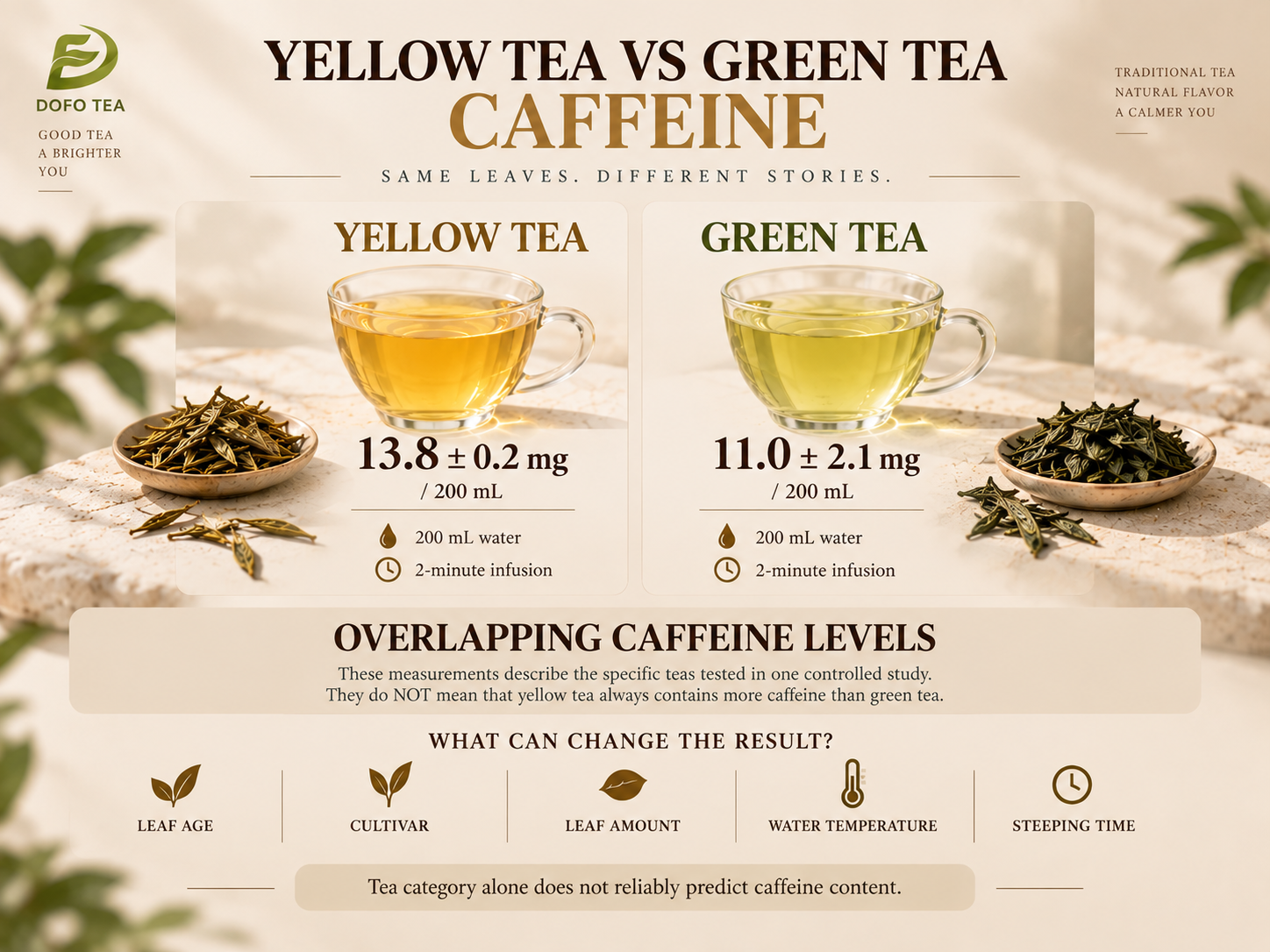
Yellow and green tea can fall within overlapping caffeine ranges, and there is no reliable rule that one category always contains more caffeine than the other. Both come from Camellia sinensis, so leaf material, leaf age, and brewing conditions can matter as much as the tea category itself. Yellow tea’s sealed-yellowing step changes its chemical and sensory profile, but it does not automatically make yellow tea lower in caffeine than green tea.
In a 2025 HPLC study of tea infusions, yellow tea contained 13.8 ± 0.2 mg of caffeine per 200 mL, compared with 11.0 ± 2.1 mg per 200 mL for green tea under the study’s tested conditions. These figures describe the specific teas and brewing conditions tested, not every yellow or green tea. A lightly brewed large-leaf yellow tea may therefore contain less caffeine than a concentrated green tea, while a bud-heavy yellow tea may contain more.
Tea also naturally contains L-theanine. Research on L-theanine and caffeine rcombined with caffeine has found effects on some measures of attention and alertness, although the doses used in controlled studies do not necessarily match those found in a normal cup of yellow tea.
For differences in processing and flavor, read the full yellow tea vs green tea comparison. For the broader wellness discussion, see yellow tea’s effects on the body.
Yellow and green tea sit in the same caffeine range—the leaf and your brewing matter more than the tea type.
How Yellow Tea Caffeine Compares to Oolong and Black Tea
In the same 2025 infusion study, the tested yellow tea and black tea showed very similar caffeine levels under one brewing condition, while the tested oolong tea was lower. These sample-specific results do not mean that yellow tea is always higher or lower than either category.
Yellow tea can overlap with both oolong and black tea in caffeine content, so tea type alone is not a reliable way to rank caffeine levels. Oolong varies widely depending on leaf material and brewing conditions; our oolong tea caffeine guide explains those differences in more detail.
Compare equal leaf weights, cup sizes, and brewing conditions rather than assuming oxidation level determines caffeine. If you want to explore the category, you can shop our yellow teas, but no untested product should be described as caffeine-free or assigned an exact milligram value.
FAQ
Does yellow tea have caffeine?
Yes. Yellow tea naturally contains caffeine because it is made from Camellia sinensis. A commonly cited estimate is approximately 32–64 mg per cup, but a controlled infusion study measured 13.8–53 mg per 200 ml as brewing conditions changed.
Does yellow tea have more caffeine than green tea?
Not necessarily. Yellow and green tea have overlapping caffeine ranges, and leaf maturity, cultivar, leaf quantity, water temperature, and steeping time can matter more than the category. One controlled study measured slightly more caffeine in its yellow-tea samples under the same two-minute condition, but that limited result does not apply to every tea.
Is yellow tea low in caffeine?
Yellow tea can fall within a low-to-moderate caffeine range, but it is not caffeine-free. Its caffeine level varies considerably between teas and brewing conditions, so it is more accurate to think of yellow tea as variable rather than inherently “low caffeine.” People who are sensitive to caffeine can use less leaf or shorter infusions to reduce extraction.
Can I Drink Yellow Tea at Night?
Yellow tea can be consumed at night, but its caffeine may affect sleep in people who are caffeine-sensitive. If caffeine tends to keep you awake, avoid yellow tea in the hours leading up to bedtime. A lighter or shorter infusion may reduce caffeine extraction, but it will not make the tea caffeine-free.


